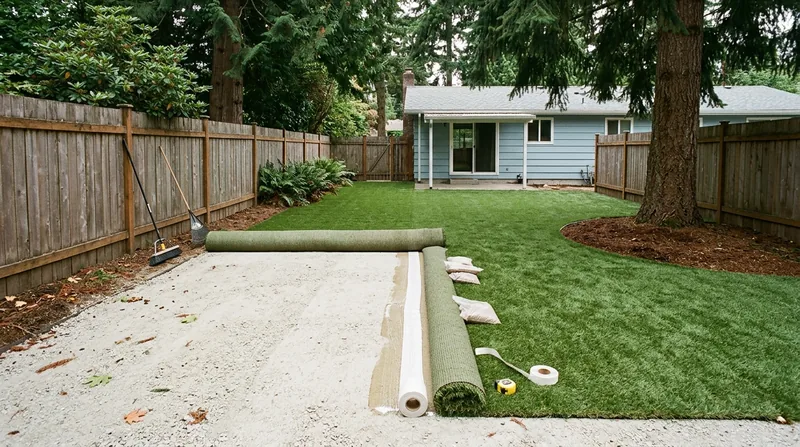




Residential artificial grass installation in Seattle transforms steep, moss-prone yards into usable outdoor living space year-round. Between the Puget Sound and Lake Washington, most Seattle homes sit on sloped lots held by timber retaining walls and rockeries, where Douglas firs and western red cedars cast dense shade and long winters turn thin lawns to mud. Artificial turf installation solves that problem directly: no moss, no mud, no thinning under the canopy, and a surface that drains and dries fast even in the grey months. We install artificial turf on residential yards across Seattle, Bellevue, Redmond, Kirkland and surrounding areas, naming the turf product, face weight, pile height, infill type and base depth in writing so you know exactly what you are getting. Since 2013, we have built turf yards for Seattle homeowners who want a low-maintenance alternative to struggling lawns without the generic install-and-walk approach. A free estimate starts with a site visit and a conversation about your yard's slope, drainage, sun exposure, and how you plan to use the space.
Why Residential Artificial Grass Installation Matters in Seattle's Wet Climate
Seattle's wet winters and dense tree cover create a unique problem for natural lawns. Moss thrives in shade and moisture, real grass thins under the fir canopy, and clay soils hold water so effectively that yards stay soggy from November through March. A struggling lawn in a Ballard Craftsman bungalow or a Northgate rambler wastes time and money on treatments that rarely work. Artificial turf installation eliminates the maintenance cycle and gives you a green, usable yard regardless of shade, drainage or season.
- Turf drains instantly in heavy rain and dries within hours, so your yard is usable even after a downpour.
- No moss, algae or fungal growth in the shade of Douglas firs and big-leaf maples.
- No fertilizer, no fungicide treatments, no aerating or overseeding cycles.
- Turf stays green and dense year-round without the thin patches that appear under tree canopy.
- Sloped yards work better with artificial grass because the surface compacts evenly and does not erode.
The result is a yard that works for families, dogs, and entertaining without seasonal decline or constant care.
Key info: Seattle's Building and Safety Division rarely requires permits for turf installation itself, but if your yard slopes steeply or requires grading that changes drainage, check with your local building department first. We handle that conversation and coordinate with locates before any excavation starts. See Seattle Department of Construction and Inspections for site-specific guidance.
How We Install Residential Artificial Grass: Seattle Yards Done Right
Proper installation is the difference between turf that lasts 8 to 10 years and turf that fails in 3. We start with a site visit to measure the yard, assess drainage, identify tree roots and irrigation lines, and discuss your expectations. Then we remove old sod or debris, build a proper base, install perimeter edging, and lay turf with seams that are invisible and reinforced. Every step is documented and tied to the product spec so you own the record of what was installed.
- Site assessment and measurement: we identify slopes, shade patterns, drainage issues, and any underground utilities.
- Removal of old sod and debris, and rough grading to match the final surface level.
- Base installation: we lay recycled asphalt or engineered base, compact it to the depth required by the turf spec, and test drainage.
- Perimeter edging: we install aluminum or steel edging along garden beds and property lines to hold the turf and prevent creep.
- Turf layout and seaming: we position the roll to minimize seams, cut and fit edges, and seal seams with adhesive and tape.
- Infill application: we spread the specified infill (silica sand, rubber, or zeolite) and brush it into the pile until the turf stands upright and dense.
- Final grooming and cleanup: we power-brush the turf, remove debris, and walk the entire yard to confirm the install is even and the seams are tight.
A typical residential yard of 400 to 600 square feet takes 2 to 3 days from start to finish. Larger yards or complex slopes take longer. We also handle turf repair and seam repair if an existing installation needs refreshing or fixing.
Local example: A Queen Anne home with a steep north-facing yard under a 40-year-old Douglas fir required a 6-inch base and extra drainage fabric because the clay soil was holding water. We graded the yard to shed water toward the street, installed the base, and laid a heat-rated 70-ounce turf with zeolite infill. The yard drains now, stays green all year, and the homeowner has not touched it in two seasons.
Installation Methods and Approaches for Seattle Residential Yards
| Approach | Description | Best for |
|---|---|---|
| Full yard removal and base build | Remove old sod, amend soil, install 4 to 6 inches of compacted base, then lay turf with full perimeter edging. | Yards with poor drainage, moss, or uneven settling; most Seattle residential jobs. |
| Overlay on existing hardscape | Install 1 to 2 inches of engineered base and drainage underlay over concrete or compacted soil, then lay turf. | Patios, balconies, or yards where excavation is not practical. |
| Slope and contour grading | Build the base to match existing slopes or create new contours for drainage or visual interest before turf install. | Sloped yards on Lake City, Northgate, and Eastside homes where water management is critical. |
| Seaming and reinforcement | Use adhesive, seaming tape, and heat welding (where permitted) to join turf rolls invisibly and reinforce high-traffic seams. | Any yard where appearance and durability matter; all residential installs include this as standard. |
Residential Artificial Grass Installation Cost in Seattle: What to Expect
Residential artificial grass installation in Seattle starts at approximately $8 per square foot for a basic install on a level yard with good drainage and accessible site conditions. Most residential yards run between $3,200 and $6,000 depending on size, slope, base depth, tree roots, and the turf product you choose. A 400-square-foot yard might cost $3,200 to $4,000; a 1,000-square-foot yard typically runs $8,000 to $12,000. The price per square foot can climb if your yard is steeply sloped, has poor drainage that requires deeper base work, sits under heavy tree cover with root obstacles, or is difficult to access for equipment.
Factors that move the cost up include the following: a deeper base (6 to 8 inches instead of 4 inches) for yards with clay soils or standing water; reinforced drainage fabric or perforated pipes for yards that hold moisture; removing old sod or concrete; grading to reshape slopes; and the face weight and infill type you select. A premium 70-ounce turf with zeolite infill costs more than a 50-ounce standard turf with silica sand, but it lasts longer and resists matting in high-traffic areas. Getting 2 to 3 estimates from local turf installation companies is the best way to understand what your specific yard will cost and why the numbers differ. Visit our pricing page for detailed cost breakdowns and examples, or call us at (425) 699-9907 for a free site estimate.
Residential Artificial Grass Installation Near Me: What Seattle Homeowners Should Know Before Hiring
Choosing the right turf installation company makes the difference between a yard that looks great for a decade and one that fails early. When you are evaluating any installer, ask for proof of insurance (a certificate naming general liability and workers' compensation coverage), a written specification that names the turf product, face weight, pile height, infill type and pounds per square foot, and base depth and compaction method. Ask for references and photos of finished work in yards similar to yours. Check whether the company is local, has a physical address in the Seattle area, and has been in business long enough to stand behind the work. If your home is in an HOA community, confirm that the installer understands HOA architectural rules for front-yard turf and is willing to help with submittals, though we never promise HOA approval. For yards with protected trees or heritage specimens, ask the installer how they will protect roots during excavation and base work.
Red flags include installers who quote a price without visiting the site, who lay turf on bare dirt without a proper base, who cannot name the turf product or infill in writing, or who disappear after the job is done. We are fully insured and we provide a written spec with every estimate. We have been installing turf in Seattle since 2013 and we keep a local address and references you can call. If you are ready to move forward, contact us for a free estimate at (425) 699-9907. We respond within 24 hours and we are happy to answer questions about your yard, your budget, and what the install will actually look like.
Residential Artificial Grass Installation in Seattle: Pricing Guide
| Service | Price | Details |
|---|---|---|
| Basic residential yard (level to gentle slope, good drainage) | Starting at $8/sq ft | Includes removal, 4-inch base, standard 50-ounce turf, perimeter edging, silica sand infill |
| Sloped or drainage-challenged yard (clay soil, standing water, tree roots) | Starting at $10/sq ft | Includes deeper 6-inch base, drainage fabric or perforated pipe, grading, premium turf, zeolite infill |
| Patio, balcony, or overlay on hardscape | Starting at $6/sq ft | Includes 1 to 2 inches engineered base and underlay on existing concrete or compacted surface |
| Complex or large-scale residential project | On estimate | Steep terrain, significant grading, multiple zones, or unusual site conditions require on-site assessment |
| Travel and site visit | Included | No separate travel charge for Seattle and surrounding service areas; estimate response within 24 hours |
| Estimate | Free | No obligation, full written spec and pricing breakdown provided after site visit |
Indicative pricing, the exact cost depends on square footage, finish, and site access. Free personalized estimate within 24h at (425) 699-9907.


