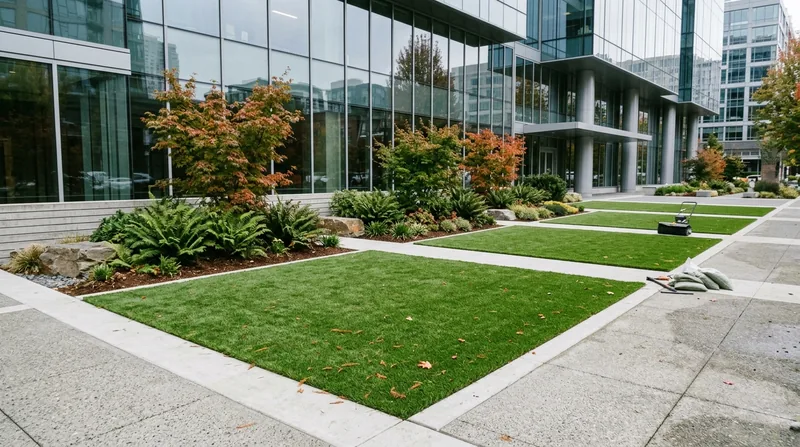




Seattle's commercial properties face unique challenges: steep hillside lots between Puget Sound and Lake Washington, dense Douglas fir and western red cedar canopy that shades grass into moss and mud, heavy winter rain that turns drainage into a constant problem, and summer dry spells that stress natural turf. Commercial artificial grass installation in Seattle gives property managers, retail owners, HOA boards and office parks a durable, low-maintenance alternative that stays green year-round without the moss, the mud, the mowing or the constant water demand. We have installed artificial turf on commercial properties across Seattle, Bellevue, Kirkland, Renton and the surrounding Puget Sound region since 2013. We name the product, the face weight, the infill and the base depth in writing, and we walk away from jobs where drainage problems or heat exposure demand a different answer.
Why Commercial Artificial Grass Installation Matters in Seattle's Wet Climate
Seattle receives nearly 38 inches of rain per year, most of it falling between October and May. Natural turf on commercial properties gets pounded by foot traffic, delivery trucks, seasonal flooding from poor drainage, and the relentless shade of tall conifers. The result is compacted soil, root rot, moss takeover, and a property that looks neglected. Commercial artificial turf installation eliminates that cycle: no seasonal die-off, no mud in the parking lot, no brown patches under the eaves, and no water bill spike during the dry summer months when property managers scramble to keep real grass alive.
- Remove the cost and liability of mowing, fertilizing and pest control on commercial grounds.
- Install a product that survives heavy foot traffic, wheeled equipment and seasonal flooding without bare spots or ruts.
- Create a clean, professional appearance that reflects well on retail frontages, office parks, apartment complexes and HOA common areas.
- Reduce water consumption on properties where irrigation costs and municipal restrictions make real turf unsustainable.
- Maintain consistent appearance across multiple properties without the seasonal variation that plagues natural lawns in the Pacific Northwest.
A well-installed commercial turf system handles the wet, the traffic and the shade that destroy natural grass in this region.
Key info: Seattle's King County does not require a permit for artificial grass installation itself, but grading that changes site drainage, work in a right-of-way or alterations to protected trees follow the rules of the city or county at your address. Check with your local building department and HOA before design begins. See the City of Seattle Permits and Inspections page for your specific zone and property type.
How We Install Commercial Artificial Grass in Seattle: Site Assessment to Finish
Every commercial property is different. A retail storefront in Ballard has different drainage and foot-traffic demands than a dog park in Redmond or an apartment complex courtyard in Kirkland. We start with a site visit to assess drainage, shade, soil compaction, existing utilities and the specific wear patterns your property will face. We then specify the turf product, infill type, base depth and compaction, and we put it all in writing before we break ground.
- Schedule a free commercial estimate: we visit the site, measure the area, assess drainage and shade, and discuss your property's specific needs.
- Provide a written specification naming the turf product, face weight, pile height, infill type and pounds per square foot, and base depth.
- Request a Washington 811 utility locate to mark underground power, gas, water and communications lines before excavation.
- Remove existing turf or pavement if needed, grade the site for proper drainage away from structures, and compact the subgrade.
- Install the specified base material (typically 2 to 4 inches of crushed rock, compacted in lifts) to support the turf and manage water.
- Lay the turf in straight lines, overlap seams by 6 inches, and secure seams with adhesive and backup tape.
- Spread infill (silica sand, crumb rubber or zeolite-based product) to the depth specified, brush it into the pile, and compact lightly.
- Edge the turf with metal or plastic edging, and inspect the entire installation for drainage, seam security and appearance.
The process typically takes 3 to 7 days depending on site size, existing ground conditions and weather.
Example: A Kirkland office park with 8,000 square feet of landscaping around the building had moss-covered turf that killed the property's curb appeal and required constant maintenance. We installed 50-ounce artificial turf over a 3-inch compacted base with zeolite infill, added proper drainage swales, and finished in 5 days. The property now requires no mowing, no fertilizer and minimal water. See our pricing guide for cost breakdowns across different property sizes.
| Approach | Description | Best for |
|---|---|---|
| Full site conversion | Remove existing turf or pavement, grade and compact the site, install base and turf from scratch. | Large commercial properties, parking lot islands, apartment complexes and retail frontages with poor existing conditions. |
| Overlay installation | Compact existing soil, add 2 inches of base material, install turf directly without excavation. | Properties where digging is risky (utilities present), budget-conscious conversions and small planter areas. |
| Hard-surface turf | Install drainage underlay and turf directly on concrete, asphalt or pavers. | Rooftop decks, patios, balconies and pool surrounds where excavation is not possible. |
| Phased rollout | Install turf in phases across the property, finishing one section at a time to minimize disruption. | Active commercial sites, office parks and multi-tenant properties where downtime must be limited. |
| Seam repair and patching | Replace lifted seams, repair melt spots from window reflections or UV damage, or patch high-wear zones. | Existing installations that need spot work, aged turf in heavy-traffic areas and properties with thermal stress. |
Commercial Artificial Grass Installation Cost in Seattle: What to Expect
The cost of commercial artificial grass installation depends on site size, existing ground conditions, the turf product you choose, infill type and base depth. A free commercial estimate is the only way to get an accurate number because every property is different. Factors that move the price include the size of the area, whether you need excavation and base prep, tree removal or limbing to improve access, drainage improvements, utilities that need protection, and the face weight and infill type you select.
For budgeting purposes, commercial installations typically range from $8 to $16 per square foot installed, depending on site conditions and product choice. A 2,000-square-foot property with good drainage and moderate site prep might land around $16,000 to $32,000. A 5,000-square-foot complex with poor drainage, steep grading and high-traffic zones could run $40,000 to $80,000 or more. The best approach is to get 2 or 3 free estimates from local turf installation companies so you can compare specifications, base depth, product quality and workmanship warranty. See our detailed pricing breakdown for more context on what moves the cost up or down.
Call us at (425) 699-9907 for a free commercial estimate with no obligation to book. We measure the site, assess drainage and shade, discuss your property's specific wear patterns, and provide a written spec before we quote a final price.
What to Look for When Hiring a Turf Installation Company Near Me in Seattle
Not all turf installers are equal. Some lay 40-ounce turf on bare dirt and leave within a day. Others skip the base prep, ignore drainage and seam the turf so poorly that it lifts within a year. A good turf installation company near Seattle will give you a written specification, answer your questions about product and infill, and stand behind the work. Here is how to vet any installer, including us.
- Ask for a certificate of insurance naming general liability and workers compensation coverage, and verify it is current.
- Request a written specification that names the turf product, face weight, pile height, infill type and pounds per square foot, and base depth and compaction method.
- Check for a local address and phone number, and confirm the company has been in business for at least 3 years.
- Ask for references from 3 to 5 completed commercial projects in your area, and call them to ask about drainage, durability and the installer's responsiveness.
- Request photos of finished work showing seams, edging and how the turf performs under foot traffic and weather.
- Discuss your property's drainage, shade and foot-traffic patterns, and listen for honest guidance about whether artificial grass is the right answer for your site.
- Confirm that the company understands HOA architectural rules if your property is governed by an HOA, and will help with submittals (though we never promise approval).
- Ask about the workmanship warranty and what it covers (typically 1 to 3 years on seams, edges and infill retention, not the turf itself).
We are fully insured, have been installing artificial turf in Seattle and the surrounding region since 2013, and we provide a written spec and a 2-year workmanship warranty on every installation. Contact us today for a free estimate and to discuss your commercial property's specific needs.
Commercial Artificial Grass Installation in Seattle: Pricing Guide
| Service | Price | Details |
|---|---|---|
| Free commercial estimate | Free | Site visit, measurement, drainage and shade assessment, written spec with product, face weight, infill type and base depth named |
| Small commercial property (up to 2,500 sq ft) | Starting at $8 to $12 per sq ft | Includes full site prep, 2 to 3 inch compacted base, seaming and standard silica or zeolite infill |
| Medium commercial property (2,500 to 5,000 sq ft) | Starting at $9 to $14 per sq ft | Includes excavation, drainage improvements, compacted base, seaming, infill and edging across larger footprints |
| Large commercial complex (5,000+ sq ft) or difficult site | On estimate | Steep slopes, poor drainage, heavy utilities, tree removal or phased rollout require site-specific pricing |
| Seam repair and patching | Starting at $300 to $800 | Per repair area; lifted seams, melt spots and high-wear zones can be fixed without full replacement |
| Travel and mobilization | Included | No separate fee for jobs in Seattle, Bellevue, Kirkland, Renton, Kent, Auburn, Federal Way and surrounding areas |
Indicative pricing, the exact cost depends on square footage, finish, and site access. Free personalized estimate within 24h at (425) 699-9907.


